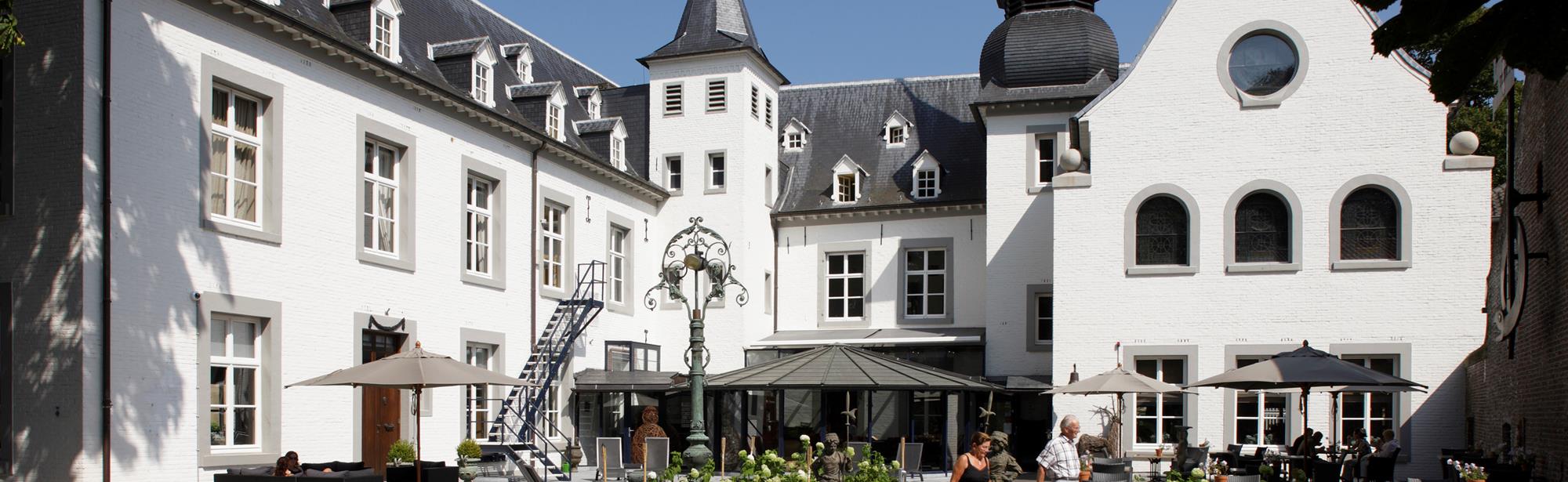
Doenrade Castle is located on the edge of the village of the same name Doenrade. The castle was built around 1117, it is one of the oldest castles in Limburg. In earlier years this castle was a castle with moats around it.
The castle was inhabited by important noble families. For example, the family Brempt (1196) and Dobbelstein (1224) were counted among the primal nobility.
Around 1300 the castle was inhabited by the family van Dobbelstein tot Doenraedt. In the first half of the fifteenth century it was owned by Godart van Dobbelstein van Doenrade, he was an official of Millen (1433) and stadtholder (1444) of the Keurkeulse Mankamer in Heerlen.
In 1429 his daughter Bela married Johan van Brempt called Lieck, guardian of Heinsberg. They continued to live on the first floor of the knight's house Unterlieck. At an older age, only in the year 1462, Bela Dobbelstein inherited Doenrade Castle.
Doenrade came into the possession of the noble family van Brempt tot Doenraedt, who also called themselves Van Lieck. Steven van Brempt, also known as Oude Lieck, was the first of the family to call himself 'van Brempt tot Doenrade'. He was a grandchild of Bela Dobbelstein.
In 1523 and 1539 there is talk of a Krein van Lieck tot Doenrade. The Van Brempt family remained the owners of Doenrade Castle until about 1700. The Van Brempt coat of arms is incorporated on a plaque of the castle.
In 1856 the subdistrict and mayor of Oirsbeek, Johan Lodewijk Christiaan de Limpens, moved from Sittard to this castle. He was born in 1793 in Doenrade and probably his parents were already the owners of this castle.
He married Baroness Catharina Josephina Sophia of Guaita. In 1886 he donated all his possessions to a foundation that still exists today: 'the beneficent foundation Jan de Limpens'. This foundation aims to help poor people.
Farmers who had setbacks due to diseases among their livestock could receive money from this foundation. For studying children one could receive tuition fees (with the exception of those who studied to become a doctor or lawyer).
After the residents of De Limpens, from 1925 on, the castle served as a nunnery where old men were nursed. From 1960 to 1969, the castle was used as a police school. From 1978 to 1985, the castle was owned by Mr. Motké, who ran a furniture store under the name Elite Meubel. From 1985, the castle served as a restaurant for another two years.
The castle is also called 'Doonderhuuske', by analogy with other smaller castles in the region north of Brunssum (Sjilvenderhuuske in Schinveld, Etzelderhuuske in Etzenrade). Judgments have been held on these castles since the Middle Ages.
As a 'court', however, they were subordinate to the higher authority of the lords of Brunssum. That is why the castle in that place bore the name Genhoes (Kasteel Op Gen Hoes), which means as much as 'the house par excellence'. The municipal name Onderbanken is a reminder of the 'sub-courts'.
Doenrade Castle stood empty from 1987 to 1991. In 1991 the renovation and renovation of the castle started. On May 1, 1993, the castle opened as Hotel & Restaurant Kasteel Doenrade.
The current whitewashed castle was built on the site of an older house since the sixteenth century. In the early 1930s, a wing and a tower were added to the castle, giving it its current form.
This text has been automatically translated using an online translation service.